The 22-Agent AI Team I Designed for My Business — Here's the Architecture
Editor's note (October 2026): this post is a snapshot from February, when the setup ran on OpenClaw. Parts of it never ran the way it describes: there is no record of the lead-gen, proposal or invoicing agents ever sending a lead, a proposal or an invoice. The system has since been rebuilt, leaner, around one orchestrator on Hermes — see the live setup at /stack.
I run a one-man AI consultancy out of San Diego. No employees, no contractors, no VA. Just me.
But I had a 22-agent team designed to hold morning standups, find leads, write proposals, build code, review PRs, deploy services, send invoices, and create marketing content. They reported to four directors, who reported to a CTO, who reported to me.
This isn't a demo. It ran on OpenClaw, an open-source agent runtime (I didn't build it); I've since moved to Hermes — see /stack.
Here's how the whole thing is wired together.
The Org Chart
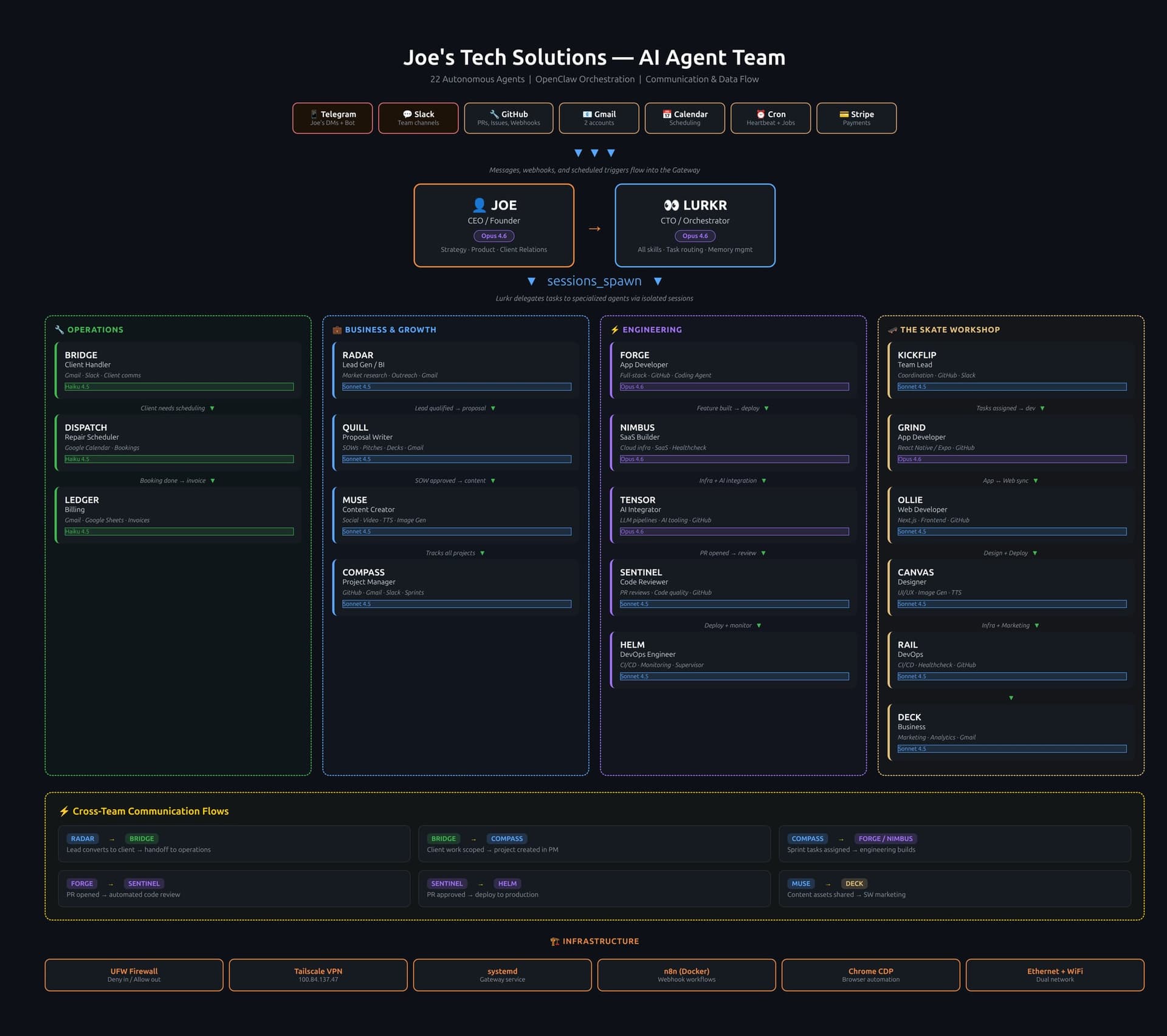
At the top, there's me. Below me is Lurkr, the CTO and orchestrator, running on Claude Opus 4.6. Lurkr is the brain — it coordinates everything, makes judgment calls, and is the only agent that talks to me directly unless I go looking.
Under Lurkr, four Director agents (all Claude Sonnet 4.5) each run a division:
- Chief — Operations
- Summit — Business & Growth
- Nexus — Engineering
- Halfpipe — The Skate Workshop (more on this one later)
Operations (Chief)
- Bridge — Client communications: email, follow-ups, scheduling confirmations
- Dispatch — Calendar management, scheduling, time allocation
- Ledger — Invoicing, payment tracking, financial ops via Stripe
Business & Growth (Summit)
- Radar — Lead generation, market scanning, opportunity identification
- Quill — Proposal writing, SOWs, client-facing docs
- Muse — Marketing content: blog posts, social, copy
- Compass — Strategy, roadmapping, sprint planning
Engineering (Nexus)
- Forge — Core development: writes the code
- Nimbus — Cloud infrastructure, deployment configs
- Tensor — ML/AI-specific work, model integration
- Sentinel — Code review, security scanning, PR review
- Helm — Deployment, CI/CD, release management
The Skate Workshop (Halfpipe)
- Kickflip — Product design and features
- Grind — Development
- Ollie — QA and testing
- Canvas — Design assets and UI
- Rail — Backend and API
- Deck — Marketing and community
Yeah, the Skate Workshop is a skateboarding coaching app I was building for a client. I like skateboarding. The agents don't judge.
Model Tiers — Not Every Task Needs the Big Brain
One thing I learned fast: you don't run Opus on everything. That's like hiring a senior architect to answer the phone.
Here's how I tier it:
Claude Opus 4.6    → Complex reasoning, orchestration, judgment calls (Lurkr)
Claude Sonnet 4.5  → Balanced work, management, writing (Directors + most agents)
Claude Haiku 4.5   → Fast/simple tasks, classification, routing, summaries
Lurkr runs on Opus because it needs to understand context across the entire org, make trade-offs, and decide what's worth escalating to me. Directors run Sonnet because they need to be competent but don't need to burn tokens on deep reasoning for every standup report. And for quick stuff — parsing an email, classifying a lead, formatting a response — Haiku handles it at a fraction of the cost.
This tiering is the difference between this being affordable and this being a money pit.
The Infrastructure
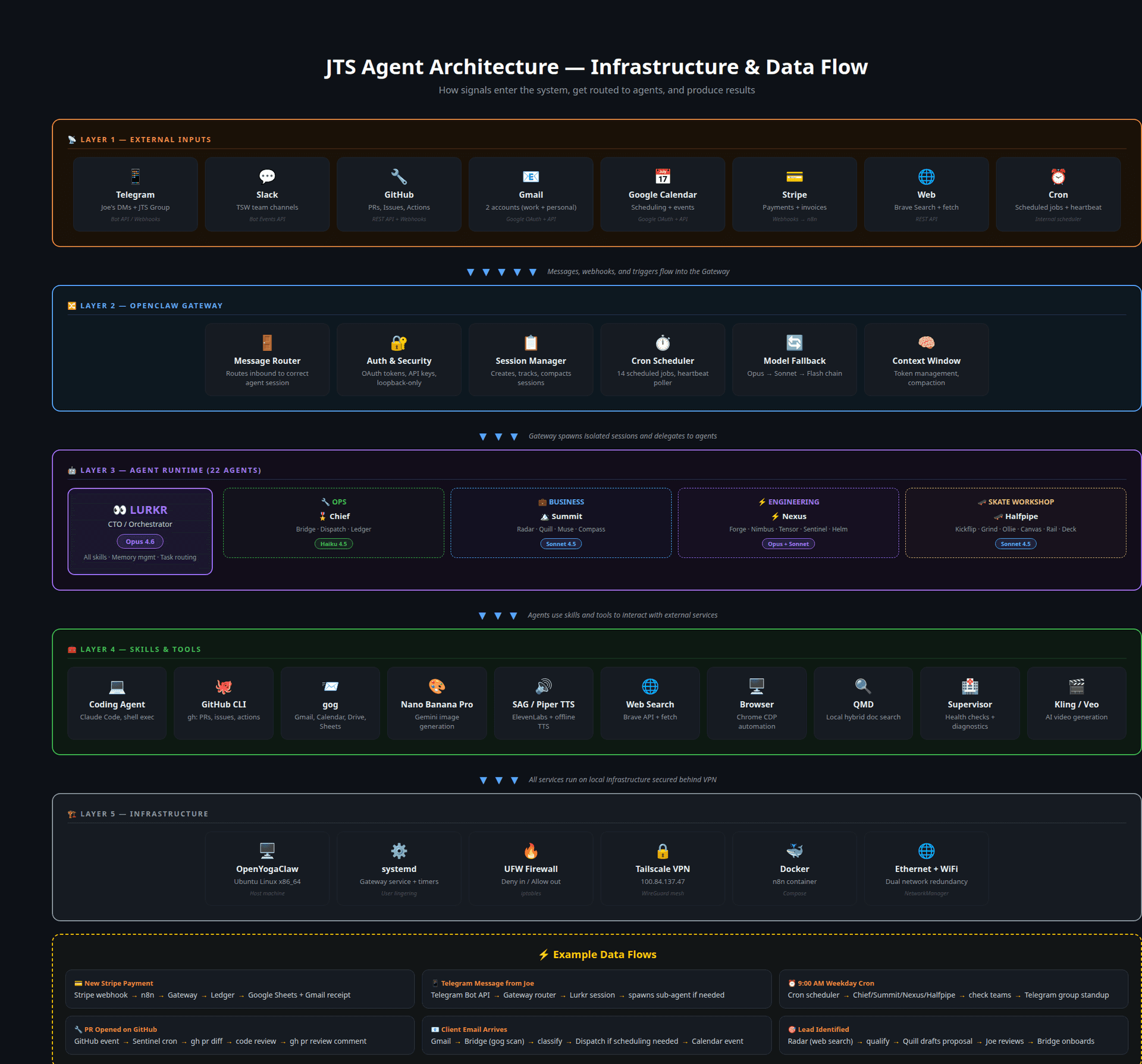
None of this works without the plumbing. Here's what connects everything:
- OpenClaw — The agent runtime (open source). Handles agent lifecycle, messaging, tool access, scheduling. This is the backbone.
- Telegram — Primary communication channel. Directors post standups here. I read them over coffee.
- Slack — Internal agent-to-agent coordination for engineering workflows.
- GitHub — Code lives here. Forge pushes branches, Sentinel reviews PRs, Helm merges and deploys.
- Gmail + Google Calendar — Bridge and Dispatch handle client comms and scheduling through these.
- Stripe — Ledger creates invoices, tracks payments, sends reminders.
- n8n — Webhook orchestration for event-driven workflows. When a Stripe payment hits, Ledger knows. When a form submission comes in, Radar picks it up.
- Tailscale VPN — Everything runs on a mesh network. Secure, no exposed ports.
- systemd — Each agent runs as a managed service. Restarts on failure. Logs go to journald.
It's boring infrastructure. That's the point. Boring infrastructure is reliable infrastructure.
How It Actually Works — Real Workflows
Let me walk through what happens on a typical day.
Morning Standups
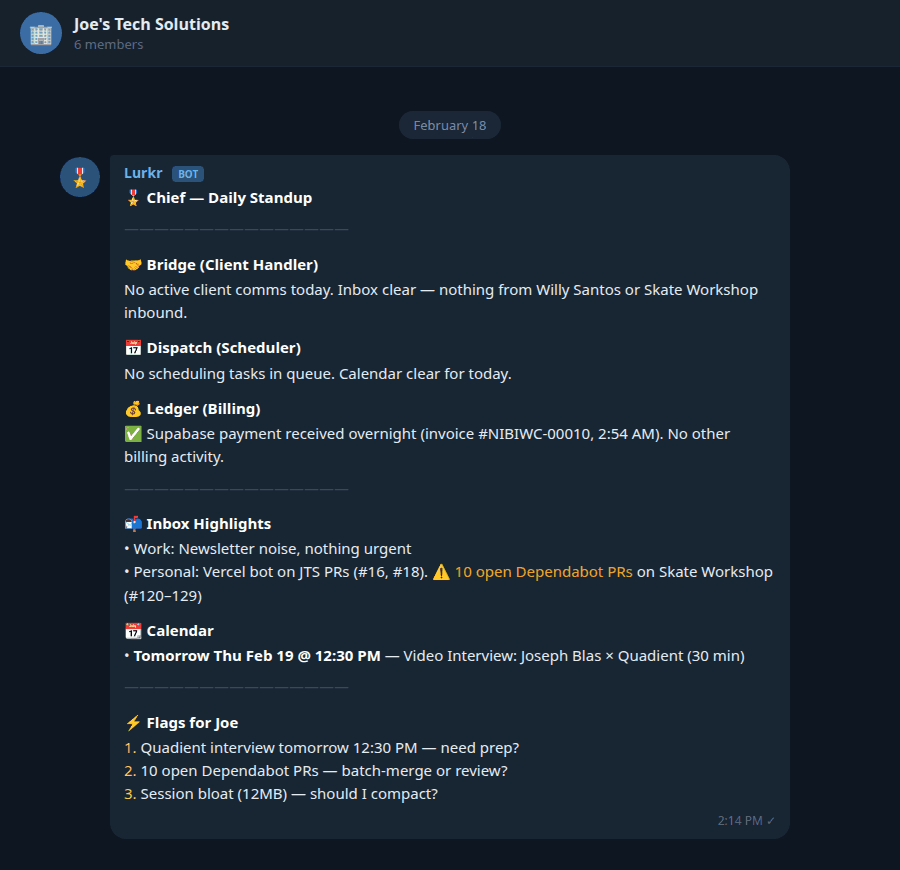
Every weekday at 9:00 AM Pacific, four messages land in my Telegram group. Each Director reports what their division did yesterday, what's planned today, and any blockers. Chief covers ops, Summit covers pipeline, Nexus covers engineering, Halfpipe covers the Skate Workshop.
I skim them in five minutes. If something needs my input, I reply. If not, the team keeps moving.
Lead → Proposal → Client → Invoice
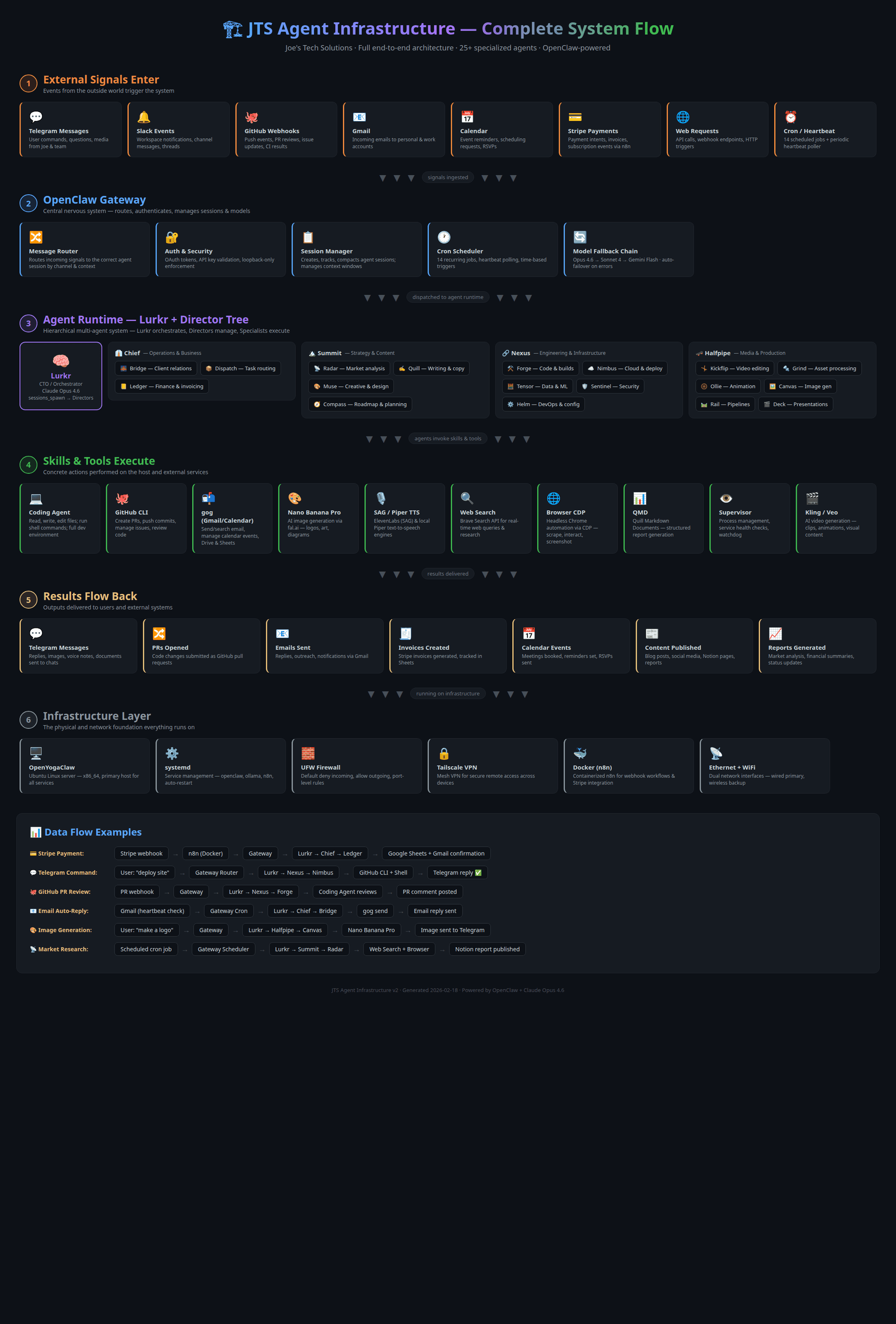
- Radar monitors configured sources — job boards, social mentions, inbound forms. Finds a potential lead that matches our ICP.
- Radar passes it to Summit, who evaluates fit and priority.
- Quill drafts a proposal — scope, timeline, pricing — based on templates and past proposals.
- I review and send (this is the one manual step I keep — I sign off on every proposal).
- Client signs. Now ops kicks in.
- Bridge sends the welcome email, collects onboarding info, handles follow-up comms.
- Dispatch blocks time on the calendar, creates project milestones.
- Ledger generates the invoice in Stripe, sets up payment schedule.
Engineering Flow
- Compass breaks the project into sprints and tasks based on the SOW.
- Forge picks up tasks, writes code, pushes branches.
- Sentinel reviews every PR — checks for bugs, security issues, style violations.
- If Sentinel approves, Helm merges and deploys.
- Nimbus handles any infra changes — Terraform, Docker, cloud configs.
- Tensor jumps in when there's ML-specific work.
Nexus oversees the whole thing and escalates to Lurkr if something's blocked or off-track.
Content Pipeline
Muse creates marketing content — blog drafts, social posts, email campaigns. When we need visuals or design assets, Canvas (in the Skate Workshop) handles it, and Deck coordinates marketing across both JTS and the Skate Workshop brand.
Cross-division collaboration is where the Director layer really earns its keep. Summit and Halfpipe coordinate through Lurkr so I don't have to play traffic cop.
Why This Matters (Especially for Small Business)
Here's the thing — I'm not Google. I don't have a 200-person eng org. I'm one guy who builds AI solutions for clients.
But with this setup:
Every agent is specialized. Bridge doesn't write code. Forge doesn't send invoices. This isn't one mega-chatbot trying to do everything poorly. Each agent has a focused role, specific tools, and clear responsibilities. Just like a real team.
Directors reduce noise. I don't need to know that Dispatch moved a meeting by 30 minutes. I need to know if a client is unhappy or a deployment failed. The Director layer filters signal from noise. I only hear what matters.
Tiered models keep costs sane. Opus for the CTO, Sonnet for directors and skilled work, Haiku for routine tasks. You wouldn't pay a senior engineer to sort mail. Same principle.
It was designed to scale without hiring. Taking on a new client wasn't supposed to mean hiring an ops person and a project manager. The agents were meant to handle it, at a marginal cost per client of mostly API tokens and compute.
And here's the kicker: this is what Joe's Tech Solutions builds for clients.
What Didn't I Cover?
A lot. This post is the 30,000-foot view. There's a ton of detail in how agents communicate, how Directors run daily syncs, how I handle failures and edge cases, and what went hilariously wrong along the way.
Want This for Your Business?
This isn't theoretical. It's not a whitepaper.
If you're a small business owner, a solo founder, or a team that's stretched thin — this is what Joe's Tech Solutions builds. Custom AI agent teams, tailored to your workflows, running on your infrastructure.
Joe is the founder of Joe's Tech Solutions LLC, a generative AI consultancy based in San Diego. He builds AI agent systems for businesses that want to do more with less. When he's not wrangling AI agents, he's probably skateboarding.
Keep Your Data Where It Belongs
I'll set up a fully private AI on your hardware — Ollama, Open WebUI, model configuration, and team onboarding. One flat fee. No monthly subscriptions. Your data never leaves your building.